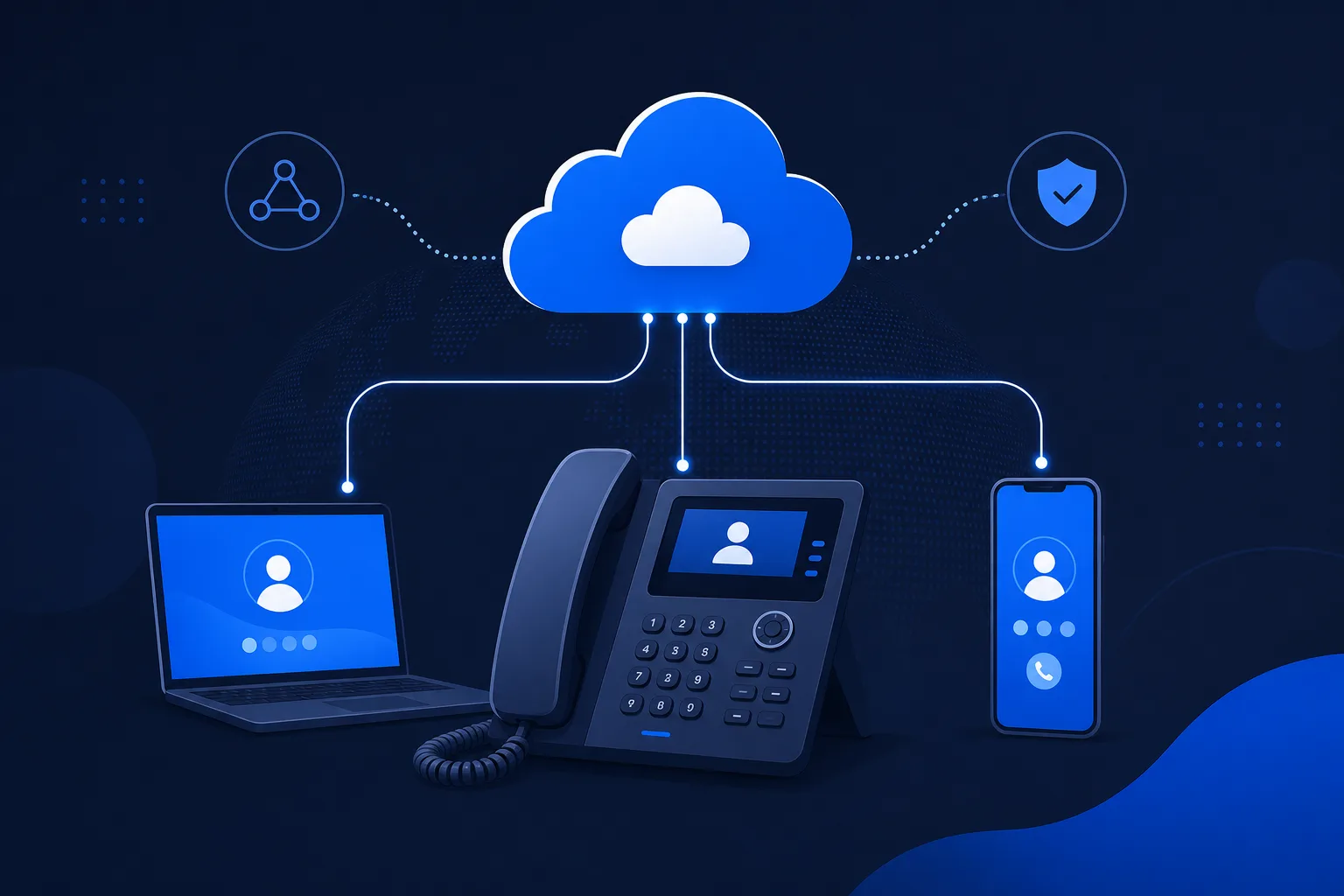
VoIP Phone Systems: What Businesses Should Know Before Switching
By The Uptime Report editorial team · Last updated September 2026
A VoIP phone carries calls over your internet connection instead of traditional phone lines, and it is now the default: 78% of enterprises and 61% of small businesses already use VoIP in 2026. The appeal is lower cost, easier scaling, and features legacy lines cannot match.
Key takeaways
- 78% of enterprises and 61% of small businesses use VoIP in 2026 (Panterra Networks).
- Businesses moving off landlines report 30-50% lower communication costs (industry surveys, 2026).
- The global VoIP phone market is valued at $66.02B in 2026, growing ~9% a year (Fortune Business Insights).
- Call quality depends on the network: bandwidth, low latency, and QoS prioritization decide whether calls are clear.
- For MSPs, VoIP is a natural add-on to an existing network engagement and adds recurring per-user revenue.
What is a VoIP phone system?
A VoIP phone system carries voice calls over the internet instead of a dedicated copper line. Your voice is broken into data packets, sent across the same connection your business already uses, and reassembled on the other end. A hosted platform handles routing, voicemail, and features, so a call to any normal phone number connects the way it always has, just over a different path.
The shift is no longer early-adopter territory. Panterra Networks reports that 78% of enterprises and 61% of small businesses run VoIP in 2026, and Fortune Business Insights values the global VoIP phone market at $66.02 billion, growing about 9% a year.
How much does a VoIP phone system cost versus traditional lines?
VoIP is usually billed per user per month, and the savings over legacy lines are consistent. Businesses migrating from traditional landlines commonly report 30% to 50% lower communication costs, with the largest savings on long-distance and international calling. The per-line charges and add-on feature fees of legacy PBX systems disappear.
| Factor | VoIP | Traditional lines |
|---|---|---|
| Billing | Per user, monthly | Per line, plus add-ons |
| Scaling | Add a user in minutes | Provision a physical line |
| Features | Routing, apps, voicemail-to-email included | Usually extra |
| Outage behavior | Needs internet or a failover | Works during internet outages |
Why does call quality depend on the network?
The one place VoIP disappoints is when the network cannot support it. Voice is real-time traffic and sensitive to jitter and latency in a way that email and web browsing are not. Before deploying, confirm there is enough bandwidth, enable quality-of-service (QoS) prioritization for voice, and check the router can handle concurrent calls. Most VoIP complaints trace back to a network that was never prepared for real-time traffic, not to the VoIP service itself.
What happens to a VoIP phone during an internet outage?
Because VoIP relies on internet access, calls do not work on the same connection during an outage. This is the one real trade-off against a traditional line. The fix is a planned failover: a cellular backup connection, or automatic call forwarding to mobile phones when the primary link drops. Any business where phones are mission-critical should design this failover before cutover, not after the first outage.
Why does VoIP fit the managed services model?
An MSP already managing a client network is the right party to run its phones. The same monitoring watches the connection that carries the calls, the same help desk supports both, and the client has one accountable vendor for connectivity and voice together. It also deepens the relationship and adds recurring per-user revenue, which is why VoIP is one of the most common service-line expansions for growing MSPs.
Frequently asked questions
Does a VoIP phone work during an internet outage?
Not on the same connection. Because VoIP relies on internet access, businesses that need phones during outages should plan a failover such as a cellular backup or call forwarding to mobile.
Is VoIP cheaper than traditional phone lines?
For most businesses, yes. VoIP is billed per user per month and avoids the per-line and add-on feature charges of legacy systems, with reported savings of 30% to 50% on communication costs.
What internet speed do I need for VoIP?
Each concurrent call uses only modest bandwidth, but consistency matters more than raw speed. Low latency and low jitter with QoS prioritization are what keep calls clear.
Can I keep my phone number when switching to VoIP?
Yes. Existing business numbers can almost always be ported to a VoIP provider, so customers experience no change.
How many businesses use VoIP in 2026?
Roughly 78% of enterprises and 61% of small businesses use VoIP in 2026, according to Panterra Networks.
Is VoIP secure for business use?
VoIP is secure when configured properly with encryption, strong passwords, and a firewall that handles voice traffic. An MSP managing the network can apply the same security controls to voice.
Leave a Reply