VoIP Call Center: How Cloud Contact Centers Work in 2026
By The Uptime Report editorial team · Last updated October 2026
A VoIP call center runs customer calls over the internet instead of traditional phone lines, and the model has gone cloud-first: 78% of call centers have migrated to cloud infrastructure, with 92% of new installations cloud-based.
Key takeaways
- 78% of call centers have migrated to the cloud; 92% of new installs are cloud-based.
- The cloud contact center market is worth $40.35B in 2026, growing ~24% a year.
- VoIP call centers enable remote agents; 73% of leaders plan long-term remote/hybrid.
- Conversational AI is projected to cut contact center labor costs by $80B in 2026.
- CCaaS (Contact Center as a Service) delivers the whole operation from the cloud.
What is a VoIP call center?
A VoIP call center handles customer calls over the internet instead of traditional phone lines, using cloud software to route, queue, record, and analyze calls. Delivered as a service, it is called CCaaS (Contact Center as a Service), the whole operation running from the provider’s cloud. The shift is nearly complete: Ringly reports 78% of call centers have migrated to the cloud and 92% of new installations are cloud-based.
How does a cloud VoIP call center work?
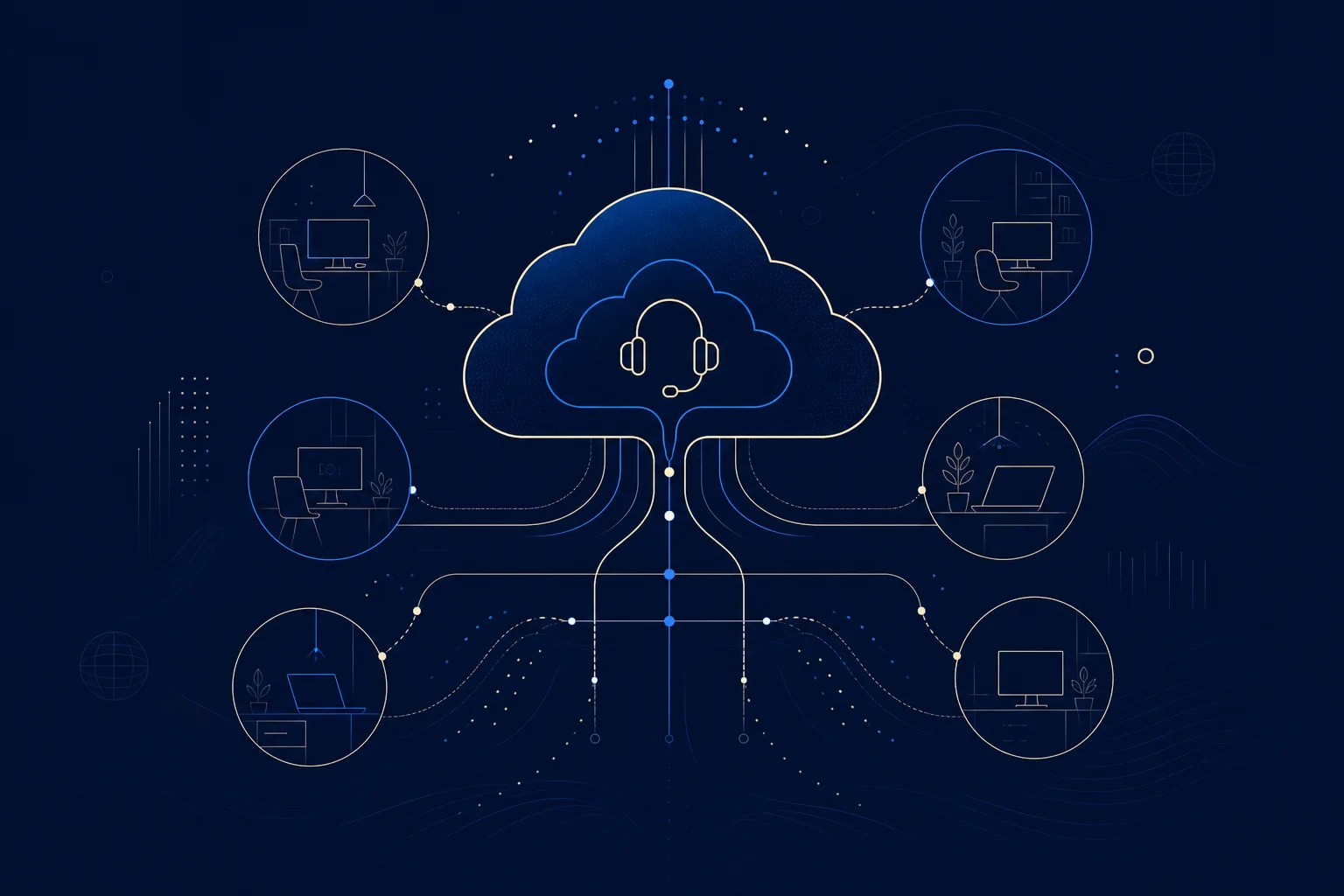
Instead of on-premise telephony hardware, a VoIP call center runs on software that connects agents, wherever they are, to a cloud platform handling call distribution, IVR menus, queuing, recording, and reporting. Because it is internet-based, agents can work from anywhere, which is why 73% of call center leaders plan long-term remote or hybrid work. The cloud contact center market is worth $40.35 billion in 2026, growing about 24% a year.
What are the benefits of a VoIP call center?
- Remote agents: staff from anywhere, not just a building.
- Scalability: add agents and capacity on demand.
- Lower cost: no on-premise telephony hardware.
- AI and analytics: automation and insight built in.
AI is a major driver: conversational AI is projected to cut contact center labor costs by $80 billion in 2026.
How is AI changing VoIP call centers?
Fast. The AI call center market reached $2.98 billion in 2026 and is growing about 21% a year. Conversational AI now handles routine interactions, projected to automate 10% of agent interactions in 2026 (up from 1.6%), and assists human agents on the rest. The result is lower cost and faster resolution, though human agents remain central for complex issues. A VoIP call center is the platform that makes adding AI practical (Fortune Business Insights tracks the CCaaS market).
Frequently asked questions
What is a VoIP call center?
A call center that handles customer calls over the internet instead of traditional phone lines, using cloud software to route, record, and analyze calls.
What is CCaaS?
Contact Center as a Service: a full call center operation delivered from a provider’s cloud, including call distribution, IVR, recording, and reporting.
How many call centers use the cloud?
78% of call centers have migrated to cloud infrastructure, and 92% of new contact center installations are cloud-based.
What are the benefits of a VoIP call center?
Remote agents, on-demand scalability, lower cost without on-premise hardware, and built-in AI and analytics.
Can VoIP call center agents work remotely?
Yes. Because it is internet-based, agents can work anywhere, which is why 73% of call center leaders plan long-term remote or hybrid work.
How is AI used in VoIP call centers?
Conversational AI handles routine interactions and assists agents, projected to automate 10% of interactions in 2026 and cut labor costs by $80 billion.
Leave a Reply